Blog

Environmental Education Research and Culture

Theater in Downtown Buffalo
Creative Commons License photo credit: @andrewghayes

I’m back from Buffalo, having attended a two day research symposium organized by the North American Association of Environmental Education (NAAEE). Held before the annual NAAEE conference, the research symposium is meant, as I understand it, to be an opportunity to talk meaningfully about “meaty” research issues and meet with a cross-section of researchers in the field. I had a good time, intellectually, academically and personally.

Some thoughts from the symposium:

Quantitative vs. Qualitative…

From the presentations and posters I attended, a high percentage of the quantitative work was being conducted by researcher working at US universities, while the opposite was true of those working at Canadian institutions.

I’m a qualitative researcher, so clearly I have something of a vested interest in the framework. I also know, living with an health researcher steeped in quantitative methods, that done well they are powerful tools for making knowledge claims.

So both paradigms have their place. I was struck, however, by the number of times I looked at completed work and thought to myself, “Boy, this project, conducted under a qualitative framework, would have really improved its quality.” In some cases, I saw work that seemed to cling to a quantitative method for the sake of clinging (e.g. the impression that quantitative methods will give you a “better” truth—less ambiguous, more objective, perhaps easier or faster to collect).

…often maps to U.S. vs. the rest of the world.

Conventional wisdom would suggest that researchers objectively match the “best” inquiry method to the question they’re trying to answer. Given that I noticed, however, something of a cultural difference between researchers in the US and other countries, I wonder if this dichotomy between quantitative and qualitative has less to do with “best” method for the inquiry and more to do with inertia behind long-standing research trajectories.

I’m not arguing that these approaches are wrong or misguided. I am, however, fascinated by my observation of the quantitative work being driven by US-based scholars.  Incidentally, I just did the quickest of lit reviews looking to see if there is work that has been done on how researchers choose their methodologies. Lots of “how to choose your methodology” type work, but nothing (not much?) on why researchers choose a particular framework.

Perhaps its worth looking at environmental education researchers to ask them how they came to choose their particular methods. I suspect that it has a lot more to do with the culture of their institution, former supervisor or impression of funding bodies than we might acknowledge. Which might be why, in part, I see such a dichotomy between the way work is done in the US and the rest of the world.

Warblers, migration, birding & ethics

Black-throated Blue Warbler male 2-20100916
Creative Commons License photo credit: kenschneiderusa

In my dissertation, I write a bit about the ethical alignments that underpin birders’ behaviours (I asked birders what rules, if any, they followed while birding). Along a continuum from human-centred (anthropocentric) to nature-centred (biocentric), the birders I spoke with shared “rules” that ran from one end to the other. Here’s an example of a human-centred perspective shared by a birder:

I don’t want to try and get too close, but I will approach one quietly and sort of let the bird—their instinct for self-preservation, you know, rule that. If you make too much noise, it’s just going to fly away. But I don’t want to disturb the bird. I want to get a good look at it but beyond that some move away.

I consider this to be more of a human-centred perspective because the birder leaves it up to the bird to decide when the birder approaches too closely. While consideration is given to the bird, the need to get a good look (appears to be) king. I write in the dissertation:

In this case, the birder is leaving it to the bird to make the decision that [the birder] is too close—by flying away. This perspective, for example, ignores the energy required for the bird to fly away and the possible negative result on the ability for the bird to survive. This is a particularly important consideration during migration when birds are expending huge amounts of energy and time to feed and refuel. Nowhere in that practice [of birding] is there any form of self-control on the part of the birder.

My own perspective about this is clear: we as birders ought to be acting with the best interests of birds in mind. If this means not getting a good look, then so be it.

Intriguingly, as I was skimming my birding blog feeds I came across this post, Warblers in Bryant Park, on the birding blog 10,000 Birds. I’ve been impressed in the kind of attention the authors of this blog have made to bird conservation. Yet, as I read this post about warblers in New York City’s Bryant Park, I couldn’t help but examine and question the underlying ethical motivations.

In short, the post described something of a warbler migration fallout in the (very urban) park. The birds were seemingly unaware of their surroundings; unaware enough that the post’s author was able to take some stunning photographs using a 100mm macro lens. “Each and every picture here is of a wild bird,” writes the post’s author, “free to go about its business.” Responses to the post were, for the majority, positive, with the exception of this one which took the birds’ perspective into mind:

Whats lost here is that these birds are exhausted, so exhausted in fact that they will risk being out with people/predators mid-day to feed and rest.

While yes the pictures are beautiful, you have to wonder if any of those birds have what it takes to migrate and return next year to breed.

Kinda makes it bittersweet.

Bittersweet indeed. Any birder knows how difficult it can be to approach a bird: that’s why we have binoculars, to collapse the space between each other. Those birds that are “easy” to approach are those accustomed to human contact (e.g. a bird that lives in urban settings, like a Pigeon) or stressed enough that our presence is the least of their concern (e.g. think about a Killdeer feigning a broken wing to distract from young).

While these were wild, migrating warblers, I think the notion that they were “free to go about [their] business” is a bit misguided. These weren’t urban birds, so it is safe to make the assumption that their behaviour, seemingly unconcerned to the foot traffic around them, was caused by something else. During migration, when they are expending large amounts of energy on flight ((Blackpoll Warblers, for example, undertake a 72 hour, 3,500 km trans-oceanic flight from the East cost of North America to their wintering grounds in South America.)), birds are stressed for food and more willing to take risks to get it. While they do have the ability to fly away, the warblers are feeding in this urban plaza precisely because they’re hungry and they are limited where they can find food. The warblers likely have very little choice in selecting Bryant Park, and disturbances can impact their ability to fuel up.

Now it is clear that the author of the post wasn’t the only human around, and the warblers were busy feeding with all this activity going on. You could say that it wasn’t a big deal to add another human to the mix—especially one that with an interest in and appreciation for the birds. This, however, is an example of that human-centred ethic I mentioned seeing in some birders. I’m not arguing that there was a better thing to do in this situation, but I am suggesting there were other courses of action that could have been taken. Like being aware, as in the case of the commenter above, of the bird’s motivations behind being so conspicuous.

The challenge I face when looking at a situation such as this one is an awareness of the larger rhetoric of birding: generally speaking, birders see the activity as a way to re-connect to the natural world, through birds. But, it’s a reconnection that is often on a birder’s own terms. And that’s the challenge of birding, in my opinion. As migratory bird populations continue to decrease, will the underlying ethics that motivate birders’ “rules” change to meet the needs of birds?

Hot millipede on millipede action?


Hot millipede on millipede action?, originally uploaded by Gavatron.

Behold what *might* be millipede sex.

As we were walking up Round Mountain, I noticed a millipede eating a small puffball. While I stopped to watch and try and photograph the event, another millipede sauntered up (not sure if millipedes saunter, but I digress) and started to feed as well. The two ended up touching at one point, and what you see here began to unfold.

My initial guess was that there was some sort of territoriality going on between the two, perhaps over the source of food. They loosely kept this embrace for five minutes or so, moving away from the fungi and down the log. Eventually, they decoupled and parted ways.

After returning home, and reading about millipede sex (which involves gonopods, modified legs around the 7th segment, two penises and transferring sperm packets) I think this was might have been what I was observing instead.

York University Dissertation Template

(almost) all of the completed dissertations in Visual Studies at UC Irvine up to 2008
Creative Commons License photo credit: G A R N E T

York University’s Faculty of Graduate Studies provides students with a list of formatting guidelines ((If you want the direct PDF link, here it is)) (requirements more like it) to assist graduate students with the preparation of their dissertation or thesis.

The rules and regulations are somewhat convoluted and, in my humble opinion, if left to the last step of preparation, a pain in the ass to integrate with work completed thus far. So follow my lead and begin formatting your chapters as you write them to match the guidelines. This will save a ton of work when you finally integrate all the chapters.

Also saving you a ton of work? A template that is formatted to meet FGS’ guidelines. Surprisingly, FGS does not provide students with such a template. So I’ll provide one:

York University Faculty of Graduate Studies Dissertation / Thesis Template (MS Word Template, compatible with editions 2007+)

Some caveats:

I’ve used the formatting of the document to create my own dissertation. I’ve tried to make sure there are no errors and its completely in line with FGS’ requirements as of September 2010, but you’re using this template at your own risk, so to speak. I’ve heard stories about the thesis secretary measuring margins and throwing 900 printed pages out because the page number was printed too low on the page, so check and double check all the requirements before you print your final version and visit FGS.

And drop a comment below if it proved helpful!

What big eyes you have…


What big eyes you have…, originally uploaded by Gavatron.

This is some species of March Fly, a soft-bodied dipertan (more closely related to mosquitoes, midges & gnats then, say, house flies). On my recent trip to the Adirondacks, they were all over the summit of Whiteface mountain the morning we visited (not really sure the significance of this).

What is particularly interesting about this genus of insects is that you can sex individuals by the size of their eyes. Males are visibly holoptic (meaning their the big compound eyes meet along the dorsal line) and females, well, not so much.

This is a dude.

Thinking about Next

Cox Creek Tunnel
Creative Commons License photo credit: mikecogh

With my dissertation all done but the crying defence, thoughts inevitably turn to answer the question, “What’s next?” I know that the sooner I have plans in place, the happier Gavan I am. I have, in fact, been thinking about this since early in the year, anticipating that I would be done and need something lined up. I’ve been mum on discussing these developments here because, in part, I either turned down opportunities or was not selected. In another parallel universe, however, I am a faculty member on a three year contract or a post-doctoral researcher in Ontario or Florida. It would appear that I’m much more accomplished in parallel universes.

Wither Place and the Liveliness of Higher Education?

Kiev Mohyla Academy
Creative Commons License photo credit: MattSh ~ Roads Less Traveled

Bill Gates is quoted today in a post on TechCrunch as saying that higher education needs to be less “place-based”. The post goes on to suggest that Gates thinks that “technology is the only way to bring education back under control and expand it”.

An interesting assumption here, especially for environmental education and higher ed: that the physical, the first-hand, the experiential will take a back-seat to the placelessness of the web and the promised access to “the best lectures in the world”. I’m not about to get all Chet Bowers-esque here and suggest that computers, the Internet and the ecological crisis are so intrinsically linked that we enter into a double-bind to use these technologies to engage with this crisis. I do think differently and find the notion of self-education / EduPunks as particularly interesting development in higher ed. As a consequence, I believe that there is possibility in this particular “reform” movement, informed by educational resources including on-line “open” courses, for technology to re-define some of the relationships of power (i.e credentialism) that exist between institutions and learners. If this is what Gates is referring to in regards to technology, then I’m all for it.

It is telling, however, to examine the cannon of open courses that are being offered. Relevant for my approach to teaching and learning, it appears as though there are no natural history of X courses on offer. True, this is likely due to the paucity of courses being offered in these kinds of topics ((And here we go with the power of institutions, again. The natural history course that I taught at York for three years couldn’t be offered this year without being put on the official course list. As a (transient) PhD student, my faculty was not going to do that, so it simply wasn’t offered.)) in the first place. But the kind of teaching that I am interested in in higher ed is distinctly situated in place.

The notion of being less-place based is (obviously) threatening to my sensibilities, but it also continues to mark the evolution of what education ought to be for ((And here is where Chet and I get along quite well.)): competitiveness in the (job, economic) market. It furthers the notion that education isn’t a process, but a product and that if you have access to the “best” lecturers, that you will have the best product—you—out in the market. Admittedly, it is hard not to get sucked into this perspective: I am, for example, at the end of my PhD and looking out at what’s next. As I formulate this next stage, “getting a job” appears to be high on the horizon. It is telling that my foremost concerns are not a cultural relationship with the more-than-human—they’re all about if I can pay rent.

Perhaps its not surprising then, in a capitalist economy, that education becomes about reproducing that system and that one of the world’s richest men is a proponent of a further abstraction—away from place—of higher education. I’ll suggest that my concern here (after figuring out how I’ll pay rent) is that while there certainly is possibility in the freedom of placelessness in higher education learning, there is too much at stake for an educator like me, dedicated to students coming to know the more-than-human. That it is possible for any discipline to take learning completely on-line, absent of any kind of materiality (e.g. hands-on learning, a greeting from a classmate, sitting all together in a lecture hall / seminar room) already suggests that Universities have already begun the process of wringing out the liveliness of education. And learners need more, not less, liveliness.

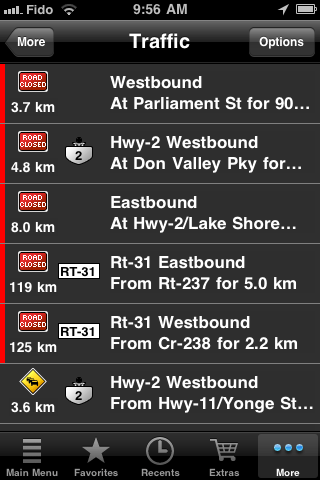
Lightning quick review of Navigon’s Traffic Live add-on for Mobile Navigator

After five days with the add-on, my thoughts.

Good: routed me off the DVP (and back on again) to successfully avoid a slow-down; it updated a route “en-route” due to new traffic information.

Bad: doesn’t show that the Danforth is closed this weekend for Taste of the Danforth (the image below shows today’s data, Bloor Street / Danforth Avenue closure absent).

In closing: good for knowing about Toronto highway traffic, poor for knowing about city road closures.

The traffic data is provided by Inrix, so the quality of this data is the limiting factor. Inrix, which has its own traffic application for the iPhone, lists the following coverage areas in Ontario: Burlington, Mississauga, Niagara, Ottawa & Toronto.

Giant Hogweed vs. Cow Parsnip vs. Water Hemlock vs. Wild Carrot

The Toronto media is ablaze with reports that Giant Hogweed (Heracleum mantegazzianum) has been found within the borders of the GTA. Normally, when an invasive species is found, it does not generate this kind of buzz. Why the hubbub? The sap of Giant Hogweed, on the skin, can lead to a severe skin inflammation called phytophotodermatitis. Many people, however, don’t know how to identify Giant Hogweed or know how tell it apart from Cow Parsnip (Heracleum maximum), a native species (and only somewhat phototoxic).

With the caveat that you should have an knowledgeable plant person confirm any identification, let me quickly outline how you figure out if that plant is Giant Hogweed or something else.

The confounding factor here is all four plants above have white flowers in an umbel (a botanical term to describe the arrangement and shape of the flowers—I’ve included an illustration of what an umbel structure looks like below).

Flower structure: Umbel

Giant Hogweed Dichotomous Key

So beginning with the assumption that you have a plant with an umbel of white flowers in the GTA, you can try your hand at identification with this key. Please be aware that this key will only work with a mature plant, and Giant Hogweed can take two years to reach the flowering stage. The key is dichotomous, meaning that you will be given two choices. Answer each question with one of the provided choices, go to number and you will come up with an identification.

1: Look at the flower.
If it is 15 cm in diameter (measured from flower edge to flower edge) or larger, go to 3
If it is 14 cm in diameter (measured from flower edge to flower edge) or smaller, go to 2

2: Good news! A small flower means that this is probably not Giant Hogweed. When mature, Giant Hogweed will have flowers up to 1 meter in diameter. It could be Queen Anne’s Lace or Water Hemlock. Note that Water Hemlock is extremely toxic if consumed.

3: Look at the stem of the plant. Is the stem reddish or purple, with spots and stiff bristles?
If yes, go to 4
If no, go to 5

4: This plant is probably Giant Hogweed. To confirm, have a look at the flower. Giant Hogweed has flowers with over 50 rays (a part of the flower structure which I’ve illustrated above). Cow parsnip will have between 15-30 rays.

5: Good news! This plant is probably Cow parsnip. It will have fine hairs, but no stiff bristles. The stem may be purplish, but is mostly green with no blotching or spots. Keep in mind that Cow Parsnip is phototoxic, too.

Keys to a Giant Hogweed ID

Just in case you hate the idea of a dichotomous key, or have questions about a non-flowering plant, here are the key differentiators between Giant Hogweed and other similar-looking plants:

  • large plant, often over 2.5 m high (when mature)
  • flowers in umbel shape, larger than 15cm in diameter
  • flowers have more than 50 rays
  • hollow stems are between 3-8 cm in diameter
  • stems have stiff white bristles
  • stems have spots or blotching, red or purple in colour
  • large, lobed leaves up to 1m in size
  • leaves compounded in three

A crystallizing moment?

OK, I should be editing my dissertation at this very moment, but I came across videos of an event on July 4th, 2010 at Okinawa Churaumi Aquarium, Japan, that I need to share. I found it to be disturbing, as a warning.

There is no doubt in my mind, especially seeing an event like this, that having cetaceans in captivity is not what ought to be done. What is fascinating, however, is to see the reactions of the other companion Dolphins and False Killer Whales. At 1:00 of the footage, the cetaceans watch (I hear echo-locating going on too, but it would be hard to determine from a video like this which of the cetaceans were making the noise) their companion through the pool’s glass enclosure.

I watch this and it makes me sick to my stomach. In part, because I feel deeply empathetic for that whale. Falling out of a pool can’t be enjoyable. While many shows like this one include the cetaceans “gliding out” of the water, the mammals do this on their stomach and are still can get themselves back into the water. Here, the False Killer Whale has no ability to do that. Imagining what that whale is thinking lying there on the concrete is overwhelming.

But it is interesting to hear the crowd’s reaction in the following clip:

As I watched this for the first time, I thought (always the researcher), “Boy, this would be a rich source of data if you could interview these people.” I wondered if this would be some kind of ethically crystallizing moment where a new perspective about whales in captivity could erupt—literally. As you listen to the reactions of the crowd, I hear gasps and giggles. More than anything, perhaps, this event simply reinforced people’s perspectives on whales—there to entertain or as innocent natural objects (or something else). That could be an interesting research question.